
Improving Semi-Supervised Semantic Segmentation with Sliced-Wasserstein Feature Alignment and Uniformity
Abstract
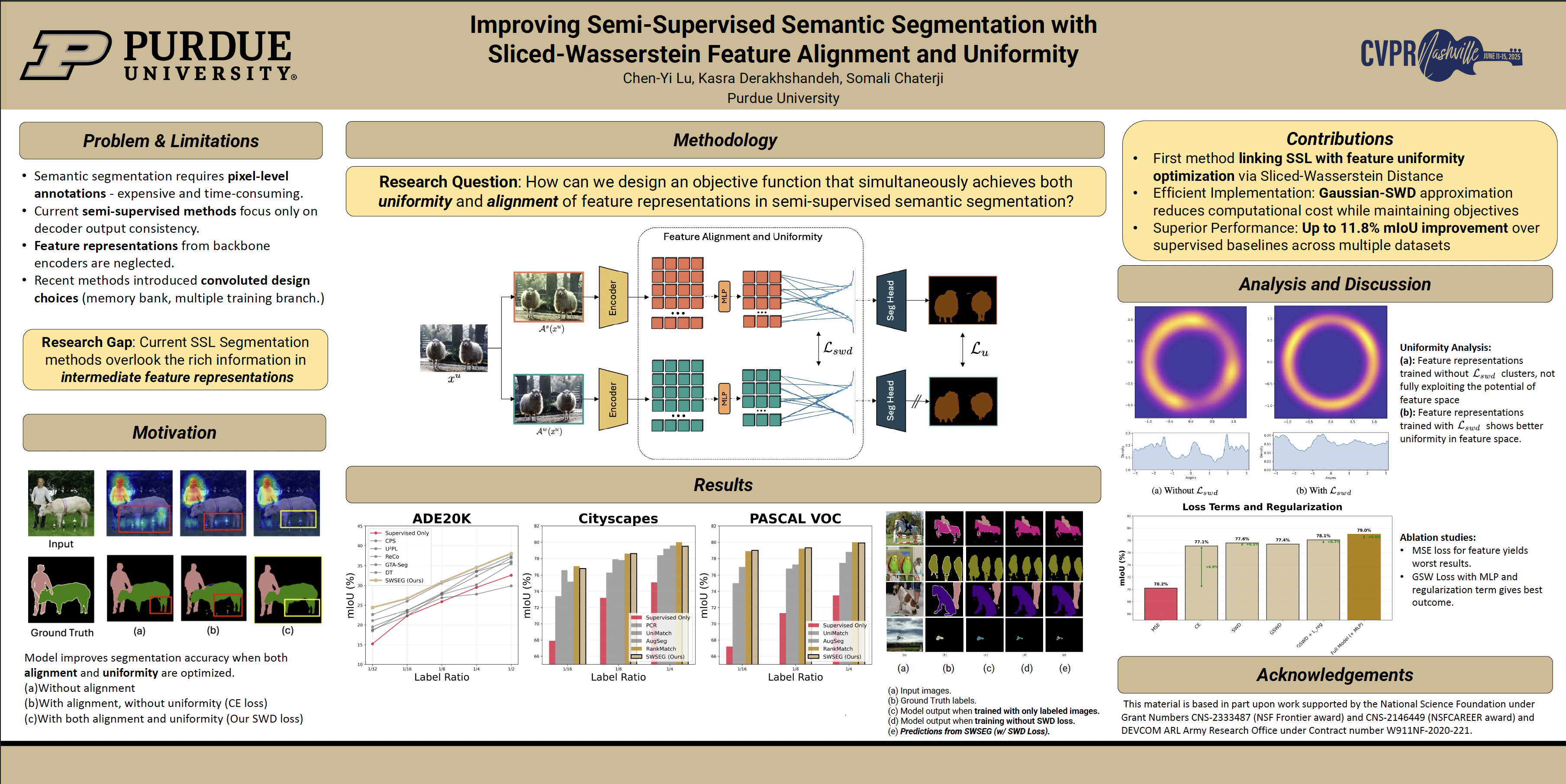
Semi-supervised semantic segmentation with consistencyregularization capitalizes on unlabeled images to enhancethe accuracy of pixel-level segmentation. Current consistencylearning methods primarily rely on the consistency loss be-tween pseudo-labels and unlabeled images, neglecting the in-formation within the feature representations of the backboneencoder. Preserving maximum information in feature embed-dings requires achieving the alignment and uniformity objec-tives, as widely studied. To address this, we present SWSEG,a semi-supervised semantic segmentation algorithm that opti-mizes alignment and uniformity using the Sliced-WassersteinDistance (SWD), and rigorously and empirically proves thisconnection. We further resolve the computational issues as-sociated with conventional Monte Carlo-based SWD by im-plementing a Gaussian-approximated variant, which not onlymaintains the alignment and uniformity objectives but alsoimproves training efficiency. We evaluate SWSEG on thePASCAL VOC 2012, Cityscapes, and ADE20K datasets, out-shining supervised baselines in mIoU by up to 11.8%, 8.9%,and 8.2%, respectively, given an equivalent number of labeledsamples. Further, SWSEG surpasses state-of-the-art methodsin multiple settings across these three datasets. Our extensiveablation studies confirm the optimization of the uniformityand alignment objectives of the feature representations.